A Preliminary Ecological Appraisal (PEA) has been prepared. The habitats on site were largely found to be of low ecological value, due to the predominance of arable land. Those habitats of most value were found to be native hedgerows / lines of trees forming field boundaries and a small copse in the southwest. These areas will be retained as much as possible and bolstered with additional planting.
Surveys have been carried out for roosting bats, wintering birds and great crested newts. These surveys confirmed the absence of newts. Nonetheless, works will adopt precautionary methods of work for amphibians, which can be included within a Construction Ecological Management Plan (CEMP). Wintering bird surveys carried out in winter 2025/2026 found the site to be of low value to wintering birds, and the impact of the development on wintering birds as negligible. Most birds recorded during the surveys were lowland species that will benefit from new proposed landscaping at the site, such as trees, shrubs, hedgerows, SUDS features, and garden habitat. As such, there is potential for the proposed development to result in a positive impact on wintering birds. There is potential for roosting bats within trees along field boundaries. Further survey work will be carried out where necessary should any of these trees require significant tree works and would be informed by detailed plans.
The site's existing green infrastructure provides a strong opportunity to retain and enhance wildlife corridors, strengthen habitat networks and deliver meaningful biodiversity gains alongside new development. Areas of woodland to the south of the site are subject to a Tree Preservation Order, with the eastern woodland parcel also including a Veteran Tree. The proposed development has been designed to ensure these valuable arboricultural features and their protection areas are not impacted by the proposed development. Through the retention of key landscape features, the creation of new habitat areas and the integration of biodiversity within public open spaces, ecology can become a defining element of the site's landscape-led approach.
Existing high value habitats will be retained, which alongside new planting and the provision of extensive areas of the site as landscaped public open space, will seek to deliver biodiversity net gain.
Building with Nature
Taylor Wimpey is proud to be a member of the Homes for Nature programme. This will see the installation of nesting bricks/boxes in every new home and hedgehog highways between gardens.
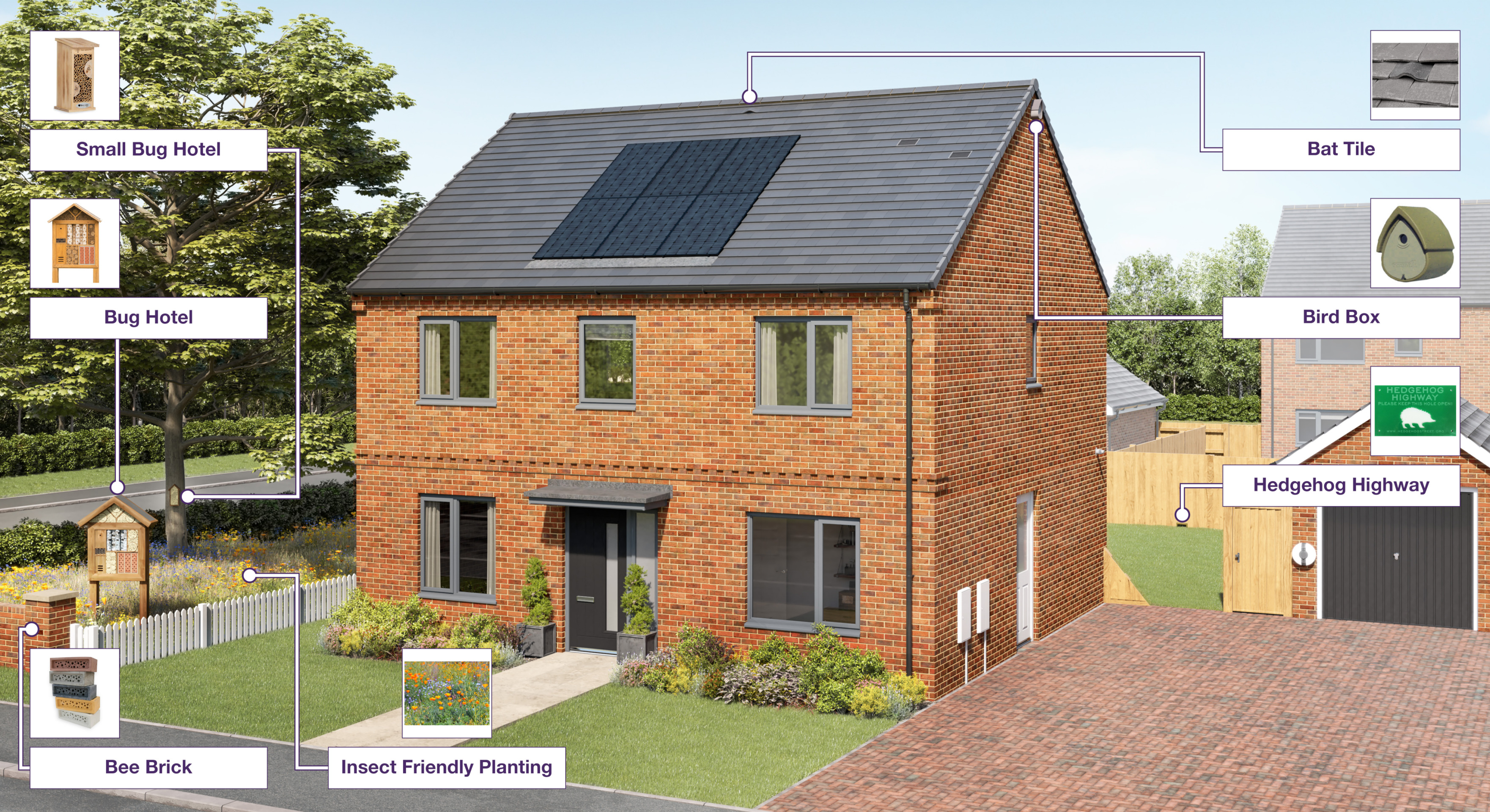
Nature interventions in a typical Taylor Wimpey home - click to enlarge